Acting UPC law firms

Last week, I attended a very informative seminar on UPC proceedings hosted by one of the major German mixed patent law firms. The presenters emphasized that they are not only registered UPC representatives (of which there are many), but also acting UPC representatives in the sense that they are presently engaged in proceedings before the UPC. As of today, only few registered UPC representatives are already engaged in ongoing UPC proceedings.  

Out of curiosity, I checked the names of the law firms acting for plaintiffs in infringement actions before the UPC, as of today (July 10, 2023). I limited my review to the main actions (of which I can access a total of 16 in the register as of today). Here is my count (please let me know if I have inadvertently missed out on your firm, in which case I will update). The list is sorted by number of main actions. For firms having filed an equal number of main actions, the firms are listed alphabetically.

Bardehle: 4 main actions

Arnold Ruess, Bird & Bird, Bonelli Erede, Clifford Chance, eip, Finnegan, Gleiss Große, Grünecker, Gulliksson, Roschier, Sandart, Wildanger: 1 main action each
Number of UPC proceedings

The UPC has opened its doors for field operation more than two weeks ago. When checking the UPC public proceedings register in the CMS, I can see 12 proceedings (three revocation actions and nine infringement actions). The nine infringement actions include three infringement actions in Munich, two in Dusseldorf, two in Hamburg. This suggests that either the CMS electronic register is not fully operational or the case numbers are much lower than the 100 cases expected to be filed within the first week according to the (optimistic) ipwatchdog blog of 31.5.2023 entitled “Countdown to the Unified Patent Court, Part V, Five Predictions for the UPC on Day One.”

Anzahl der UPC-Verfahren

Das UPC hat vor mehr als zwei Wochen seine Arbeit aufgenommen. Wenn ich das Register der öffentlich einsehbaren Verfahren des UPC im CMS verwende, werden mir derzeit (16.06.2023) 12 Verfahren angezeigt (drei Nichtigkeitsklagen und neun Verletzungverfahren). Zu den neun Verletzungsverfahren gehören drei in München, zwei in Düsseldorf und zwei in Hamburg. Dies deutet darauf hin, dass entweder das elektronische CMS-Register noch nicht voll funktionsfähig ist oder die Fallzahlen viel niedriger sind als die 100 Fälle, die laut dem (optimistischen) ipwatchdog-Blog vom 31.5.2023 mit dem Titel “Countdown to the Unified Patent Court, Part V, Five Predictions for the UPC on Day One” erwartet wurden.

Isolierte Nichtigkeitsklage am UPC

Beim Testen einiger Funktionen der CMS-Suchwerkzeuge, die vom UPC CMS bereitgestellt werden, habe ich soeben bemerkt, dass am 2. Juni 2023, also am zweiten Tag des Gerichts, eine isolierte Nichtigkeitsklage (d. h. eine Nichtigkeitsklage, die keine Nichtigkeitsgegenklage in einer Verletzungsklage ist) bei der Zentralkammer des UPC in München eingereicht wurde. Das Patent ist ein Bündelpatent (d. h. keine einheitliche Wirkung), da es vor dem 1. Juni 2023 erteilt wurde.

Der Streitwert beträgt 100 Mio. EUR. Ein Rechtsstreit zwischen denselben Parteien über ein US-Patentfamilienmitglied des nunmehr vor dem UPC angegriffenen Patents wurde kürzlich vom Obersten Gerichtshof der USA in der Rechtssache Amgen vs. Sanofi entschieden. Der US-Fall betraf die interessante Frage der ausführbaren Offenbarung über den gesamten Anspruchsbereich, d.h. die Frage, wie breit unabhängige Ansprüche im Vergleich zu den spezifischen Ausführungsbeispielen abgefasst werden dürfen.

Dies ist ein würdiger Anfang für das UPC-System, das offensichtlich interessante Fälle anzieht.

Bedauerlich ist, dass trotz der Bemühungen, ein modernes, vollelektronisches System einzurichten, die Nichtigkeitsklage gemäß R. 4.2 UPC (UPC CMS funktioniert nicht korrekt) offenbar in Papierform eingereicht wurde.

UPC isolated revocation action

When testing some of the functionalities provided by the UPC CMS search tools, I came to realize that an isolated revocation action (i.e., a revocation action that is not a revocation counterclaim in an infringement action) has been lodged with the UPC central division in Munich on June 2, 2023, i.e., the second day of field operation. The patent is a bundle patent (i.e., no unitary effect, as it has been granted prior to June 1, 2023).

The value in dispute is 100 Mio. EUR. A lawsuit between the same parties regarding a U.S. patent family members of the patent now challenged before the UPC was recently decided by the U.S. Supreme Court in Amgen vs. Sanofi. The U.S. case dealt with the interesting question of enabling disclosure over the full claim scope or, stated differently, the degree to which independent claims may be generalized as compared to the specific embodiments (which were considered to be disclosed in an enabling manner in the U.S. case).

This is a worthy start for the UPC system, which clearly attracts interesting cases.

It is a bit unfortunate that, notwithstanding all efforts to set up a modern, all electronic system, the revocation action appears to have been filed in paper form pursuant to R. 4.2 UPC (UPC CMS not working properly).

Technically qualified judges at the UPC

A couple of days ago, one of the technically qualified judges (a colleague from France who is highly respected and very well-known in the community) announced that he will resign from the position as technically qualified judge (TQJ). In his view, the recently published UPC Code of Conduct makes it difficult to discharge of the duties as a TQJ in a manner that is compatible with an attorney’s work for his/her clients.

While this resignment is a significant loss for the bench of the UPC, this ethics and level of reflection is to be applauded. It also contrasts nicely with the “the part-time judge system works for the Swiss Federal Patent Court, hence it is going to work for the UPC”-attitude that I have sometimes heard in the past. (Just to be clear: Of course, such a system can work, but concerns as regards potential conflicts of interest are to be taken seriously.) It will be interesting to see whether this resignment will remain an isolated event or whether more TQJs are going to re-consider the situation in the weeks or months to come.

Technisch qualifizierte Richter am UPC

Vor einigen Tagen hat einer der technisch qualifizierten Richter (ein Kollege aus Frankreich, der in der Gemeinschaft hoch angesehen und sehr bekannt ist) angekündigt, dass er sein Amt als technisch qualifizierter Richter (TQJ) nicht antreten wird. Seiner Ansicht nach ist im Hinblick auf den UPC-Verhaltenskodex die Erfüllung der Pflichten eines technisch qualifizierten Richters mit der Arbeit eines Anwalts für seine Mandanten schwer in Einklang zu bringen.

Dieser Rücktritt ist zwar ein erheblicher Verlust für das UPC, aber diese Art von ethischem Verhalten und Reflexion sind zu begrüßen. Dieses Verhalten steht auch in angenehmem Kontrast zur häufig geäußerten Einstellung der Art: “das System der nebenamtlichen Richter funktioniert beim Schweizer Bundespatentgericht, also muss es auch beim UPC funktionieren”. (Nur um das klarzustellen: Natürlich kann ein solches System funktionieren, aber die Bedenken hinsichtlich möglicher Interessenkonflikte sollten ernstgenommen werden). Es wird interessant sein zu sehen, ob dieser Rücktritt ein Einzelfall bleibt oder ob in den nächsten Wochen oder Monaten weitere TQJs die Situation neu überdenken werden.

UPC Case Management System (CMS)

At present (mid-May 2023), the UPC CMS appears to have difficulties handling the number of opt-out requests that are being submitted. This does not appear to be a great start for the new system:

First, while the number of opt-out requests appears to be substantial (and appears to grow significantly as June 2023 approaches), this type of request does normally not involve significant data amounts. This leaves one wondering how well equipped the CMS is to handle the potentially simultaneous submission of several voluminous briefs in UPC field operation from June 2023.

Second, the number of opt-out requests appears to illustrate that there are many applicants and patentees who, at least as of now, are not yet convinced by the new system.

On the bright side, applicants and patentees appear to be aware of the options provided by the new system, and appear to pro-actively take the steps they deem appropriate for their patent portfolio.

Patent mit einheitlicher Wirkung

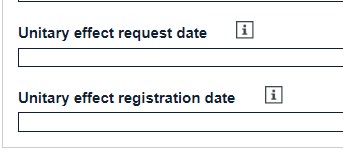
Wie mir gerade bewusst wurde, hat das EPA das Rechercheformular für Suchen im Europäischen Patentregister bereits angepasst, um die Möglichkeit der Antragsstellung auf einheitliche Wirkung zu berücksichtigen. Das aktualisierte Suchformular bietet Suchfelder für die Eingabe des Antragsdatums und des Registrierungsdatums für die einheitliche Wirkung.

Patent with Unitary Effect

I just realized that the EPO has already updated the European Patent Register search form in view of the possibility to file a request for a unitary effect. The updated search form provides search fields for entering the request date and the registration date for unitary effect.