Enabling disclosure for AI inventions

In decision BPatG 19 W (pat) 32/20, the German Federal Patent Court affirmed a decision refusing a German patent application for lack of enabling disclosure. According to the reasons of the decision (in particular section II.5.2(3)(iii)), the Senate considered the structure of the AI model to be insufficiently disclosed. The Senate also considered the information on the training data to be insufficient, in particular when it comes to how the training data are used to train the ANN structure to provide the desired output quantity (relating to wear of a technical system).

By way of background, it is rare that an application or patent is considered insufficiently disclosed by the German Patent and Trademark Office or by the German Federal Patent Court. This applies in particular in the arts that are considered “predictable arts” (physics, mechanics, etc.). The decision reflects a strict practice with regard to AI-based inventions, as also evidenced by the EPO Boards of Appeal.

There appears to be a tendency in the office practice (in particular in the EPO Boards of Appeal) to affirm refusals of applications or revocations of patents for AI-based inventions, based on lack of inventive step, when the invention relates to using AI in a novel, specific field of use. The office’s rationale is often that using AI is a general trend and the skilled person would consider the use of AI in a novel field without exercise of inventive skill. Little consideration appears to be given on the burden imposed on the skilled person for training an AI model to make it amenable for the novel use. There appears to be a discrepancy between (a) such a lack of inventive step rationale and (b) the strict criteria imposed by the office practice and the EPO Boards of Appeal / the German Federal Patent Court (see cited decision) on the disclosure of an application/patent. One can only hope that the EPO, GPTO, and BPatG will find a more balanced view in the future.
Acting UPC law firms

Last week, I attended a very informative seminar on UPC proceedings hosted by one of the major German mixed patent law firms. The presenters emphasized that they are not only registered UPC representatives (of which there are many), but also acting UPC representatives in the sense that they are presently engaged in proceedings before the UPC. As of today, only few registered UPC representatives are already engaged in ongoing UPC proceedings.  

Out of curiosity, I checked the names of the law firms acting for plaintiffs in infringement actions before the UPC, as of today (July 10, 2023). I limited my review to the main actions (of which I can access a total of 16 in the register as of today). Here is my count (please let me know if I have inadvertently missed out on your firm, in which case I will update). The list is sorted by number of main actions. For firms having filed an equal number of main actions, the firms are listed alphabetically.

Bardehle: 4 main actions

Arnold Ruess, Bird & Bird, Bonelli Erede, Clifford Chance, eip, Finnegan, Gleiss Große, Grünecker, Gulliksson, Roschier, Sandart, Wildanger: 1 main action each

Number of UPC proceedings

The UPC has opened its doors for field operation more than two weeks ago. When checking the UPC public proceedings register in the CMS, I can see 12 proceedings (three revocation actions and nine infringement actions). The nine infringement actions include three infringement actions in Munich, two in Dusseldorf, two in Hamburg. This suggests that either the CMS electronic register is not fully operational or the case numbers are much lower than the 100 cases expected to be filed within the first week according to the (optimistic) ipwatchdog blog of 31.5.2023 entitled “Countdown to the Unified Patent Court, Part V, Five Predictions for the UPC on Day One.”

UPC isolated revocation action

When testing some of the functionalities provided by the UPC CMS search tools, I came to realize that an isolated revocation action (i.e., a revocation action that is not a revocation counterclaim in an infringement action) has been lodged with the UPC central division in Munich on June 2, 2023, i.e., the second day of field operation. The patent is a bundle patent (i.e., no unitary effect, as it has been granted prior to June 1, 2023).

The value in dispute is 100 Mio. EUR. A lawsuit between the same parties regarding a U.S. patent family members of the patent now challenged before the UPC was recently decided by the U.S. Supreme Court in Amgen vs. Sanofi. The U.S. case dealt with the interesting question of enabling disclosure over the full claim scope or, stated differently, the degree to which independent claims may be generalized as compared to the specific embodiments (which were considered to be disclosed in an enabling manner in the U.S. case).

This is a worthy start for the UPC system, which clearly attracts interesting cases.

It is a bit unfortunate that, notwithstanding all efforts to set up a modern, all electronic system, the revocation action appears to have been filed in paper form pursuant to R. 4.2 UPC (UPC CMS not working properly).

Technically qualified judges at the UPC

A couple of days ago, one of the technically qualified judges (a colleague from France who is highly respected and very well-known in the community) announced that he will resign from the position as technically qualified judge (TQJ). In his view, the recently published UPC Code of Conduct makes it difficult to discharge of the duties as a TQJ in a manner that is compatible with an attorney’s work for his/her clients.

While this resignment is a significant loss for the bench of the UPC, this ethics and level of reflection is to be applauded. It also contrasts nicely with the “the part-time judge system works for the Swiss Federal Patent Court, hence it is going to work for the UPC”-attitude that I have sometimes heard in the past. (Just to be clear: Of course, such a system can work, but concerns as regards potential conflicts of interest are to be taken seriously.) It will be interesting to see whether this resignment will remain an isolated event or whether more TQJs are going to re-consider the situation in the weeks or months to come.

Patent with Unitary Effect

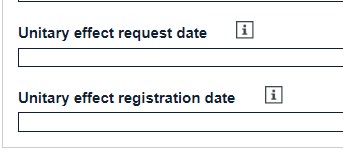
I just realized that the EPO has already updated the European Patent Register search form in view of the possibility to file a request for a unitary effect. The updated search form provides search fields for entering the request date and the registration date for unitary effect.

Injunctive relief

Section 139 of the German Patent Act deals with the most important consequences of a finding of patent infringement, including injunctive relief. In the 2021 revision of the German Patent Act, section 139 was revised. Revised section 139(1) s. 3, 4 now specifies that there can be circumstances in which patentee is not entitled to injunctive relief. There was (and still is) some uncertainty as to how much of a change this amendment means as compared to the previous version which did not include these exceptional provisions.

A recent decision of the Regional Court Düsseldorf provides guidance on section 139 of the German Patent Act as revised in 2021. In the decision LG Düsseldorf of July 7, 2022, 4c O 18/21 – Sofosbuvir, the Regional Court Düsseldorf held that section 139(1) s. 3 is applicable only in very exceptional circumstances and only subsidiarily to compulsory license proceedings. Thus, based on this decision, it appears that injunctive relief is still available in all those cases in which the infringing party has not initiated compulsory license proceedings.

EPO – strawman’s appeal fee

A new EPO Boards of Appeal decision T 84/19 deals with an interesting question relating to appeal fees. The decision holds that an opponent who is a natural person or otherwise entitled to benefit from the reduced appeal fee does not have to pay the full appeal fee, even if there is a secret sponsor (akin to the ‘real party in interest’ in post-grant proceedings in other jurisdictions). This holds as long as the opposition does not constitute a circumvention of the law regarding the entitlement to pay a reduced appeal fee.

By way of background for the readers familiar with or otherwise interested in USPTO post-grant proceedings: According to decisions G 3/97, G 4/97, it is not required that the ‘real party in interest’ be named in EPO opposition proceedings. Thus, the situation may (and does) occur in which an opponent as party to the EPO proceedings may be different from the person interested in the revocation or amendment of the patent.

EPO Opposition Matters 2022 conference

Very interesting professional training event at the EPO – Opposition Matters 2022. Lots of practical advice as regards opposition proceedings in general, and specifically oral proceedings and amendments of a party’s case. Very engaging presenters and very useful practical tips. The event materials and recordings of the key presentations will be made available at the EPO e-learning center. You may want to check this out if you are involved in EPO oppositions.